LLM Debt: The Double-Edged Sword of AI Integration

Have you noticed how half the posts on LinkedIn these days feel like they were written by an LLM – too many words for too little substance? Or how product roadmaps suddenly include “AI features” that nobody asked for, just because it sounds good in a pitch deck? Or those meetings where someone suggests “let’s use GPT for this,” when a simple SQL query, an if-statement, or a much simpler ML model would do the job?

Laurence Tratt recently coined the term LLM inflation to describe how humans use LLMs to expand simple ideas into verbose prose, only for others to shrink them back down. That concept got me thinking about a related phenomenon: LLM debt.

LLM debt is the growing cost of misusing LLMs — by adding them where they don’t belong and neglecting them where they could help.

We’re all familiar with technical debt, product debt, and design debt1 — the shortcuts or missed opportunities that slow us down over time. Similarly, organizations are quietly accumulating LLM debt.

So, what does LLM debt look like in practice? It’s a double-edged liability:

  • Overuse: Integrating LLMs where they’re unnecessary adds latency, complexity, cost, and stochasticity to systems that could be simpler, faster, and more reliable without them. For example, sending every API request through a multimillion-parameter model when a simple regex or deterministic logic would suffice.
  • Underuse: Failing to adopt LLM-based tools where they could genuinely help results in wasted effort and missed opportunities. Think of teams manually triaging support tickets, writing repetitive documentation, or analyzing text data by hand when an LLM could automate much of the work.

Like product or technical debt, a small amount of LLM debt can be strategic: it allows experimentation, faster prototyping, or proof-of-concept development. However, left unmanaged, it compounds, creating systems that are over-engineered in some areas and under-leveraged in others, which slows product evolution and innovation. Same as other types of debt, it should be owned and managed.

LLMs are powerful, but they come with costs. Just as we track and manage technical debt, we need to recognize, measure, and pay down our LLM debt. That means asking tough questions before adding LLMs to the stack, and also being bold enough to leverage them where they could provide real value.

If LLM inflation showed us how words can expand and collapse in unhelpful cycles, LLM debt shows us how our systems can quietly accumulate inefficiencies that slow us down. Recognizing it early is the key to keeping our products lean, intelligent, and future-ready.
  1. I previously wrote about some of those topics here and talked about them in Hebrew here ↩︎

Thoughts on Tech Debt

I have been thinking about tech debt for a while now and how to address it daily. Few dilemmas for example – 

  • Should we update our Python version or a version of one of the packages we use?
  • We thought of a more efficient implementation for one of our functions. Should we invest time in it? When?
  • What task should we prioritize for the next sprint? 

How do we measure our technical debt? Are we getting better, and what does better means? Or at least not worse?

So I have compiled a small reading list that I can share with my team and align on terminology and ideas. Feel free to add your thoughts.

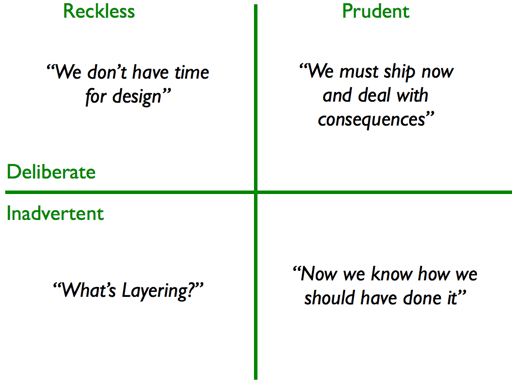
The 4 main types of technical debt – this is an explanation of Martin Fowler’s Technical Debt Quadrant. This is a first step towards establishing a common language about technical debt.

https://blog.codacy.com/4-types-technical-debt/

The different types of technical debt – Another piece in the puzzle to use a common terminology. While the split into categories makes sense, I don’t entirely agree with the fixes and impacts.

https://techdebtguide.com/types-of-technical-debt

The 25 Percent Rule for Tackling Technical Debt – a post from Shopify engineering blog about their pillars of tech debt and a recommendation on how to invest time on those topics. That made me think about whether the discussion about tech debt should differ between different stages or sizes of companies

https://shopify.engineering/technical-debt-25-percent-rule

A Framework for Prioritizing Tech Debt – this post tries to get the analogy closer to real debt and examine the interest rate. If I took this analogy one step further, I would say that it is a loan, and the prioritization and the remediations are the terms that we choose on loan, and sometimes those terms change either because we recycle the loan, win a big sum and can pay back, etc. Or because something external changed, e.g., interest rate.

https://www.maxcountryman.com/articles/a-framework-for-prioritizing-tech-debt

Tech Debt Isn’t a Burden, It’s a Strategic Lever for Success – the approach here is closer to the loan analogy – “view tech debt as a strategic lever for your organization’s success over time”. That, together with other points in this post, made me think about the relations and interactions of product debt and tech debt – are they correlated or independent, and what influences them? are there any patterns in this duo or maybe trio (with business debt). I didn’t yet find something to read about the topic that I was happy with.

https://www.reforge.com/blog/managing-tech-debt

7 Top Metrics for Measuring Your Technical Debt – this post suggests several metrics to measure technical debt, such as code churn, cycle time, code quality, and tools for measuring technical debt. One issue is that it does not cover infrastructure debt or process debt. For example – the complexity of deploy process, duplication between repositories, etc. Additionally, the underlying assumption in this post is that “tech debt is bad,” while I view it as a strategy or a trade-off. I also don’t believe that one size fits all – if you want to measure, choose the one thing that is most important and informative for you, and don’t worry if it changes over time.

https://dev.to/alexomeyer/8-top-metrics-for-measuring-your-technical-debt-5bnm