In recent weeks, I completed Northwestern University’s Organizational Leadership Specialization on Coursera. While the courses span different topics- storytelling, social influence, negotiation, and more- two recurring themes stood out to me.
1. Preparation changes everything Effective leadership and communication rarely happen “in the moment.” Preparation matters – even when you don’t yet know the formal frameworks or terminology.
Whether it’s thinking through your BATNA (Best Alternative to a Negotiated Agreement), identifying your ZOPA (Zone of Possible Agreement), or simply anticipating objections, the key habit is stepping into the other side’s perspective before the interaction happens. Strong outcomes are usually built long before the conversation begins.
2. The audience is the message People are driven by different motivations, constraints, and perceptions. That means the same message can land very differently depending on how – and to whom – it is delivered.
Leadership is not just about what you say, but how you tailor it: language, framing, medium, and emphasis all matter. This is something I first learned as a scout leader, and it has stayed with me for nearly 25 years. It remains one of the most consistently useful leadership principles I’ve encountered.
At the same time, I’ve often seen a common anti-pattern: leaders trying to motivate others based on what motivates them, rather than what actually drives the person in front of them. Good intent, misaligned execution.
Ultimately, both lessons point to the same idea: leadership is less about projecting your intent and more about deeply understanding context – both the situation and the people in it.
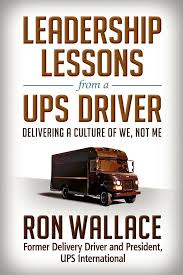
Ron Wallace started as a UPS driver in rural Idaho in 1966 and retired 36 years later as President of UPS International, running operations in 200+ countries. His book, “Leadership Lessons from a UPS Driver,” turns that climb into a handful of blunt, unglamorous principles. Here are four insights that stayed with me –
1. Best 5 vs 5 best.
Five average players who move as a unit beat five stars who don’t. With AI blurring roles – PMs writing code, engineers writing specs – how well a team moves together matters more than any one person’s skill ceiling.
2. Manage yourself before you manage others.
You can’t ask for discipline you don’t have. When everyone has an agent doing part of their job, self-management – what to delegate, what to check, what to own – is the whole game.
3. 10% planning, 90% execution.
That ratio assumed execution was the bottleneck. Agents and other tools now handle much of the execution. Does the split flip? Not sure – bad planning just produces fast, wrong output at scale. But the balance is shifting, and finding the new ratio is one of the more interesting problems before us.
4. Change is inevitable; growth is optional.
UPS survived by repeatedly outgrowing its own identity. Feels like the line of the year – nobody’s job description is stable, and adapting is a choice, not a default.
Fun fact about me – I played Rugby Sevens for years, including on a national team. It taught me more about engineering leadership than I expected. Small teams, huge space, high speed – Sevens and modern engineering run on the same dynamics.
Here are 7 lessons Sevens taught me about engineering leadership.
1️⃣ It’s Not About Weight – It’s About Teamwork
The first lesson I learned came from scrumming with a weight disadvantage but a huge coordination advantage. In Rugby (in 15s even more than in 7s), you don’t win scrums because your players are heavier. A team wins because: you bind together, you push at the same moment, you trust the rhythm. In lineouts, timing matters more than height, and coordination matters more than individual strength.
In engineering, this shows up everywhere:
A brilliant engineer misaligned with the team slows progress.
A “lighter” team moving in sync outperforms a group of heavy hitters pulling in different directions.
Velocity is not the sum of individual forces. It’s a synchronized force.
Lesson: Coordination multiplies talent.
2️⃣ Communication should be Constant and Loud
In Rugby Sevens, silence is dangerous. Players shout constantly:
“Inside!”
“Switch!”
“Up!”
“Blind!”
It’s not noise – it’s alignment. There’s too much space and speed to assume others know what you’re thinking.
In an office, you get accidental alignment:
Body language
Whiteboard moments
Corridor clarifications
In remote work, silence becomes ambiguity. If communication isn’t explicit and frequent, gaps appear.
Lesson: Constant communication creates alignment.Alignment brings results.
3️⃣ You Can Only Pass Backwards
In rugby, you’re only allowed to pass the ball backwards.
If you want to move forward, you must either run forward yourself or align with teammates who are already in motion
You can’t throw the ball ahead and hope someone figures it out. The constraint forces structure.
To gain ground, teams spread wide.
They create overlap.
They run support lines before they’re needed.
They time short, precise passes.
You go forward by passing backward – and that only works with discipline. In engineering, this principle shows up everywhere. You can’t “pass forward” sloppily:
Product can’t throw half-defined specs over the wall
Engineering can’t push messy code to QA
Leadership can’t announce strategy without alignment
When work is tossed ahead without positioning and support, the play breaks. Real velocity doesn’t come from heroic sprints. It comes from synchronized movement.
Too many handoffs? You lose momentum. Too few? You get isolated and tackled.
In Sevens tournaments, you play multiple games on the same day.
Win big? Reset. Lose badly? Reset.
The next kickoff has no memory.
Engineering teams often carry emotional baggage:
A big launch → complacency
An outage → overreaction
Strong teams don’t ignore outcomes – they process them quickly. They celebrate briefly, learn fast, and show up focused for the next “game.”
Lesson: Don’t let yesterday’s result dictate today’s execution.
5️⃣ Scoring Under the Posts vs Securing the Try
In rugby, when a player breaks through, they often try to run closer to the center before grounding the ball.
Why? Because it makes the conversion kick easier.
But that extra effort increases the risk of being tackled and losing the try entirely.
In engineering:
Do we ship now?
Or optimize a bit more?
Refactor first?
Polish the UI further?
Sometimes we optimize the conversion and lose the try.
Lesson: Secure value first. Optimize second.
6️⃣ You Don’t Always Need More Resources – Just a Change of Angle
In Sevens, attacking the wide-open side is obvious. Great teams exploit the blind side instead.
You don’t need more force. You need better perspective.
In engineering:
Reframing a product problem
Reorganizing teams instead of hiring more
Solving a process issue instead of pushing harder
Sometimes the breakthrough isn’t scaling effort – it’s shifting angle.
Lesson: Strategy beats brute force.
7️⃣ Commit Fast – Adjust Faster
In Rugby Sevens, hesitation kills.
Pause before a tackle, you miss. Delay the pass, the overlap’s gone. Half-commit to a line break, and you get isolated.
The game rewards decisiveness.
Engineering leadership is the same. Over-analysis drains momentum. Once you pick a direction, the team needs full commitment – not tentative buy-in where everyone’s still hedging.
But here’s the nuance: when a defender overcommits, great players side-step. Decisiveness doesn’t mean rigidity. You commit fully, and when new information shows up or the situation shifts, you adjust fast – without ego, without drama.
A sense of humor is one of the most underestimated leadership skills
Following the recommendation in “The Great CEO Within” I listened to “The One Minute Manager”. In one of the chapters, they mention the usage of Humor as a leadership tool. It is not about becoming a comedian but rather showing up as humans. Humor is a powerful and often overlooked tool. Why it matters:
Humor helps build trust and rapport – people are more likely to engage and collaborate when they feel comfortable and connected.
It can reduce stress and tension, boosting well-being and performance.
Humor makes leaders more approachable and memorable, signaling confidence and emotional intelligence.
Shared laughter fosters psychological safety, helping teams voice ideas and take risks.
Of course, balance is key – humor should complement clarity and respect, not replace them. Too many jokes or poorly timed humor can actually backfire, so think of it as a strategic leadership tool, not a default setting. It’s about knowing when a light moment can lower defenses, reset the room, or simply remind everyone that work is done by humans, not robots.
Measuring Engineering Productivity – Measuring engineering productivity is a topic that has been discussed as long as the field of engineering has existed. This post acknowledges the tension of measuring engineering work (where metrics can be easily manipulated). It proposes a pragmatic system of minimal burden, high visibility, and context-sensitive metrics, rather than focusing on lines of code.
Stop Avoiding Politics – Politics usually have a bad name, but the article argues that avoiding the “politics” of an organization doesn’t remove politics; it just removes your ability to influence outcomes and let others decide for you. This is a helpful reminder that part of seniority is engaging in stakeholder dynamics, not just writing code.
Team Dynamics after AI – This post critiques the rush to utilize AI to scale engineering artifact production and argues that what matters most remains the “illegible” human and team elements: context, feedback loops, diversity of roles, and the social glue that holds work together. I link it to the “Measuring engineering productivity” post in the sense that simply measuring throughput or artifacts might miss the hidden “team health” or context dimension.
Useful Engineering Management Artifacts – This is a practical collection of templates for various purposes, including team charters, career development plans, and decision briefs. It complements the productivity and team dynamics posts by providing actual artifacts you can use to operationalize some of the ideas.
Stop Caring So Much About Your People – I find this post a bit weird. In the post “Radical Candor” era, it feels obvious that giving feedback is both essential and meaningful. I agree with the author’s point that leaders sometimes over-prioritize team happiness at the expense of organizational health, and I’d extend that further: over-protecting people from discomfort also hurts their own growth. As leaders, giving feedback is often uncomfortable, but it’s one of the most valuable things we can do – to help our people, our teams, our company, and even ourselves evolve.



 Tom Ron